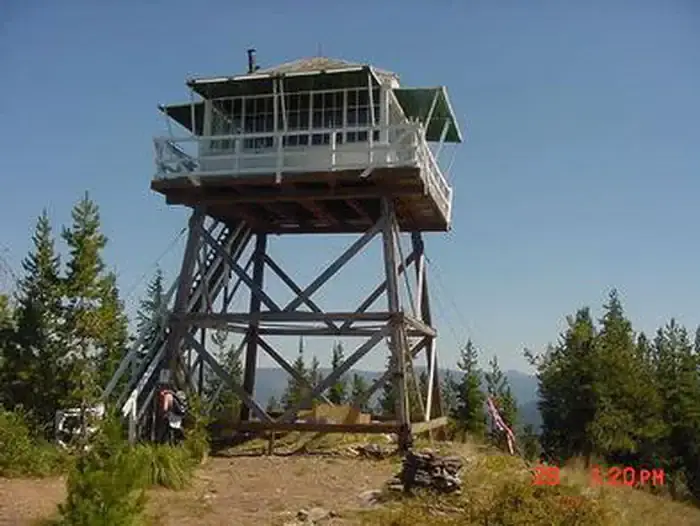
Arid Peak Lookout
Avery, Shoshone County, Idaho. Fire tower; Maintenance Closure for 2026.
Details

- Where
- 34 HOYT DRIVE HC BOX 1, Avery, ID 83802. Directions
- Getting there
- From Avery, head north up the North Fork of the St. Joe River Road #456 toward Wallace 4.5 miles; turn left just before the bridge across the river onto single-lane gravel Road #1997, drive 3.5 miles, then stay on Road #1997 another 6.5 miles to Trailhead #175. From the trailhead the cabin is reached by a moderately-steep 3 mile hike.
- Access
- Listed as under maintenance closure for 2026 by the Forest Fire Lookout Association; the recreation.gov descriptive page still describes the lookout as available for rent, so the closure is the current operating status.
- Walk-in or reserve
- Entry is by combination lock; the combination is provided on the reservation confirmation.
- Phone
- 208-245-2531
- Website
- recreation.gov
- Managed by
- Idaho Panhandle National Forests.
- Established
- 1934.
- Coordinates
- 47.3588889, -115.7652778.
The lookout on Arid Peak is a one-room cab on a 20-foot tower in the St. Joe River country of the Idaho Panhandle National Forests, in Shoshone County. The Recreation.gov listing gives it a 360-degree view of the Bitterroot Mountains. Below it lie the Loop Creek drainage and the old bed of the Milwaukee Road, now the Hiawatha Bicycle Trail. The Forest Service puts the tower at 5,306 feet. The National Historic Lookout Register puts it at 5,241. Douglas fir and spruce grow on the slopes around it, and the listing says elk, deer, black bears, moose and bald eagles are common sights. In a 1996 account, bear grass and Indian paintbrush grew on the rocky ridge beneath the tower.
The Forest Fire Lookout Association lists Arid Peak under maintenance closure for 2026. The Recreation.gov page still describes it as a public rental.
Two cots and a fire finder
Entry is by combination lock. The cab sleeps four. It holds two cots with mattresses, a table with two chairs, a wood stove, a propane lantern, a propane camp stove, water containers, dishes and basic cooking gear. Two accounts also list a replica fire finder. The outhouse stands outside the tower.
The propane runs on 16.4-ounce canisters, which guests bring themselves. Guests also pack in their own bedding, food, binoculars, flashlights, towels, toilet paper and dish soap, along with plenty of blankets and warm clothes for cold nights. Food goes into rodent-proof containers, and one container is provided. There is no drinking water. The nearest spring is a half-mile down a steep trail, and its water must be boiled and treated. Pets and smoking are not allowed. A regional guide says the lookout is not recommended for small children. A 2006 Spokesman-Review piece gave the agency’s reason: the cabs and catwalks of these lookouts are high enough that a child who fell could be injured or killed.
Three miles from Trailhead #175
Avery has the nearest conveniences. Wallace lies about 23 miles to the north by road, according to the 2006 account. From Avery the directions run north up the North Fork of the St. Joe River on Road #456 for about 4.5 miles. Just before the bridge, the route turns left down the hill onto Road #1997, a single-lane gravel road with pullouts. About 3.5 miles on, it turns left onto the first road, which is also numbered 1997, and continues 6.5 miles to Trailhead #175. A turnaround and a gate lie just past the trailhead, and cars park in the wide spot beside it.
From there the hike climbs 1.5 miles up Trail #175 to its junction with Trail #173, then 1.5 miles more on #173 to the peak. The Forest Service calls the hike moderately steep and says access depends on the weather. The Arid Peak, Mozier Peak (#174) and Kyle Creek trails all start near the lookout and serve day hikers, backpackers and riders on horseback. The Hiawatha trail can be reached a little more than 10 miles away. The Forest Service describes it crossing seven trestles and passing through 10 tunnels.
Watching the Milwaukee Road
The Forest Service and the 2006 newspaper account both give 1934 as the year the lookout was built. The National Historic Lookout Register says its 20-foot L-4 hip-roof cab with catwalk was built in 1931. All the sources agree on its purpose. It stood in a roadless area above the Milwaukee Road to catch fires set by passing trains, and, the 2006 account adds, by lightning.
Paul Wilson, a retired Forest Service fire control officer, remembered that work. In July 1996, sheltering from the summer heat under the tower, he recalled the watchers on their wooden scaffolding waiting for a spark from the trains. “They kept us busy,” he said. “In those days, there was no road. We came in here with a pack string to bring in supplies.” Water came from a spring down a steep slope. “The routine was wash dishes, bathe, windows,” Wilson said. “They used water right down the line because it was so scarce.” At night the watchers could see the lights of the Hiawatha passenger train swinging down the valley.
Forest Service archeologist Cort Sims told of a repair job years earlier, when nails were sent up to the peak by air. “They dropped him a box from an airplane and it was like shrapnel — nails everywhere,” Sims said. “They don’t deliver things like that today.”
The sources differ on when the watch ended. The Forest Service says the lookout was last staffed in 1969 and then sat idle for more than 25 years. The 1996 newspaper story places its summer occupants on the tower from the 1930s into the 1970s and says it was abandoned in the ‘70s. The Register records that the tower legs were replaced in 1969. Elsewhere, hundreds of Idaho lookouts were burned or destroyed once they were no longer needed. Among them was one that straddled the Bitterroot Divide. Wilson kept photographs of some of them going up in smoke, including one of the outhouse at Shefoot Mountain Lookout, which he titled “The hottest outhouse in the St. Joe.” Author Ray Kresek wrote that the St. Joe and Clearwater region once had 383 lookouts.
Rigging from a Pullman stage
C. Rod Bacon of the Forest Fire Lookout Association nominated Arid Peak to the National Historic Lookout Register. It was entered on October 2, 1995, as US 153, ID 12. In 1996 Gary Weber, an assistant fire management officer with the Forest Service, counted it among 15 registered lookouts in the Panhandle and called it the oldest still standing in the St. Joe Ranger District. The Forest Service says more than 30 volunteers, the Forest Fire Lookout Association and the Forest Service did the restoration. The 2006 account dates the work to a two-year effort that began in 1996, and the Forest Service gives 1997 as the year it was restored.
In the second week of July 1996, Wilson and five other volunteers and Forest Service workers hiked in every day from a nearby logging road. A helicopter had flown the materials in. A canvas tent on the ridge below the tower held generators, saws, wrenches, rigging and nails. Bacon and Sims worked under the cab’s sagging catwalk to replace one of the “caps,” the support beams for the cabin, wearing hard hats and harnesses and moving slowly. Bacon was the technical director and stage manager of the Beasley Performing Arts Coliseum in Pullman, where he rigged stage lights and other suspended structures. “We couldn’t have done it without this equipment,” Sims said, pointing to the rigging. The catwalk decking and railing were to be replaced later that month, and stairs built.
Bacon had spent eight summers manning and maintaining Middle Sister Lookout, one of three active lookouts left in the district. Standing on the top rung of a ladder propped against Arid Peak, he looked across toward it. “You can just barely see it from here,” he said.
Notable Events
- 1934Built to detect fires sparked by lightning and railroad engines. spokesman.com
- 1969The lookout was last staffed in 1969 and sat idle for over 25 years. recreation.gov
- 1969The tower legs were replaced in 1969. web.archive.org
- 1995Registered as US 153, ID 12 on the National Historic Lookout Register. web.archive.org
- 1996Thirty volunteers, the Forest Lookout Association and Forest Service personnel restored the lookout in a two-year effort beginning in 1996. spokesman.com
- The restoration feature says Arid Peak Lookout was abandoned in the '70s. spokesman.com
People
- Cort Sims, Forest Service archeologist who recalled the earlier repair-delivery story at Arid Peak.
- Gary Weber, Forest Service assistant fire management officer who provided historic-lookout register context for Arid Peak.
- Paul Wilson, Volunteer in the Arid Peak Lookout restoration crew.
- Rod Bacon, A catalyst for restoring Arid Peak; technical director and stage manager at Beasley Performing Arts Coliseum in Pullman, with rigging expertise.
- C. Rod Bacon, nominated the lookout to the National Historic Lookout Register, FFLA.