American River Hatchery
Gold River, Sacramento County, California. Fish hatchery.
Details

- Where
- 2101 Nimbus road, Gold River, CA 95670. Directions
- When
- Open 8:00 a.m. - 3:00 p.m.
- Getting there
- From Highway 50, 18 miles east of Sacramento. Go north on Hazel Avenue 0.7 miles, then west at the signal light onto Gold Country Blvd. The entrance to the parking lot will be about 200 yards on the right.
- Access
- The Nimbus Visitors Center is directly adjacent to the American River Hatchery. Dogs MUST be leashed. No bicycles are permitted on the hatchery grounds. Public restrooms are not available.
- Phone
- (916) 358-2865
- Managed by
- State of California Department of Fish and Wildlife.
- Established
- 1968.
From Highway 50, 18 miles east of Sacramento, the way in is north on Hazel Avenue for 0.7 miles, west at the signal onto Gold Country Boulevard, then about 200 yards to a parking lot on the right. The American River Hatchery lies along the river in eastern Sacramento County, below Nimbus and Folsom dams. It has concrete raceways and a hatchery building with two large circular tanks on its south side. The Nimbus Visitors Center stands directly next door. The American River Parkway trail runs alongside the grounds, and a nature trail follows the river on hatchery land for watching wildlife. Dogs must be leashed, bicycles are not permitted on the grounds, and there are no public restrooms.
The California Department of Fish and Wildlife runs the hatchery to raise trout and inland salmon for recreational fishing. A department report of February 2017 put the output at more than 2.5 million trout a year, planted in lakes, rivers and streams in 15 counties of northern and central California, waters fished by more than a quarter of a million anglers.
Four fish in the tanks
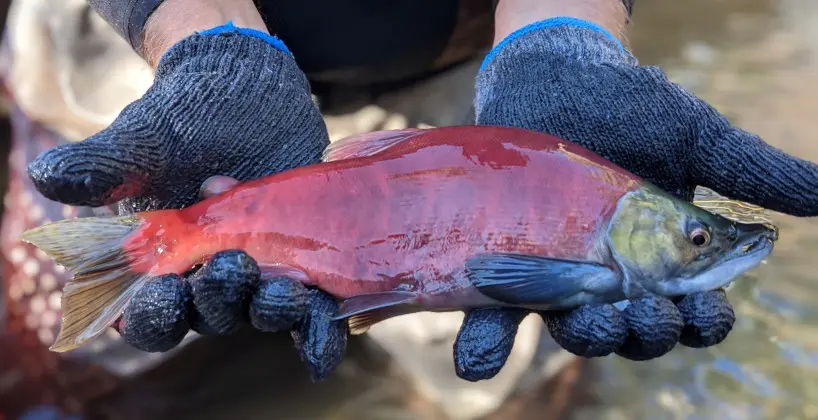
The department lists four kinds of fish reared here. The Eagle Lake strain of rainbow trout is native to Eagle Lake and its Pine Creek tributary and is known for its resistance to highly alkaline water. When flows into Pine Creek diminished, a program begun in the 1950s set out to preserve it, and the strain now lives in many waters across the state. Kokanee are landlocked sockeye salmon that take on a deep red hue when they spawn; those raised here come from eggs spawned at the Little Truckee River and other places in California. The ordinary rainbow trout raised for angling are sterile triploids. Lahontan cutthroat trout of an independent strain are kept as broodstock in Heenan Lake in the Sierra Nevada. Their juveniles are reared here for release to waters throughout the department’s North Central Region, and a 2015 release named the eastern Sierra lakes and streams among them. That same 2015 release described rainbow fingerlings bound for west-side Sierra put-and-grow fisheries by airplane.
Lake Natoma by gravity
The water comes downhill from Lake Natoma, the reservoir formed by Nimbus Dam. It runs through pipelines 30 and 32 inches across and moves through the hatchery in a flow-through system of about 52 cubic feet per second. Inside the newer hatchery building, eggs hatch and fry are reared in aluminum tanks. That building’s supply passes through a drum filter that removes solids and two ultraviolet sterilizers that kill fish pathogens. Chillers can cool the water by up to 10 degrees Fahrenheit. Heat exchange plates take the chill from water leaving the facility and pass it to water coming in, and the building recirculates and reconditions its water. Discharge from this hatchery and its neighbor drains to earthen settling ponds before it reaches the river.
The ground is United States Bureau of Reclamation property. The department’s Nimbus Hatchery shares it, along with the Water Pollution Control Laboratory, the Aquatic Bioassessment Laboratory, the Fish Health Laboratory, and the North Central Region headquarters. At the start of the American River Discovery Trail stands a marker titled “The Treasured American River.” The Historical Marker Database places it at the Nimbus Fish Hatchery. Its inscription reads: “The river before you is not the same river that flowed through here 200 years ago when the Nisenan Indians caught salmon and collected acorns along its bank. The river has been mined, dammed and surrounded by our cities, yet it still supports healthy runs of Chinook salmon and steelhead.”
The marker’s panels fill in that change. Gold was found at Sutter’s Mill about 30 miles upstream in 1848. On these banks Chinese miners dug deep trenches into the gold-bearing gravel and washed it in pans and sluices. Starting in the late 1890s, dredges scooped up the old riverbed between Sunrise Boulevard and Folsom’s old town. By 1962, when dredging stopped, more than $125 million in gold had come out of the gravel, and miles of salmon spawning beds lay in ruin. That same year, according to another panel, community leaders adopted the first parkway plan, and the county bought riverside land for the 23-mile American River Parkway.
A hatchery on paper, 1952 to 1968
A trout hatchery here was planned more than a decade before one was built. The Department of Fish and Game’s biennial report for 1952–1954 recorded that the Wildlife Conservation Board had allocated $40,000 for land, which was to come from the federal government, for a proposed hatchery already called by this name. The report added that there were no immediate plans to build it until the need was fully demonstrated. The same report counted 1,600,000 license holders in 1952 and 1,871,000 two years later. It described trout fishermen “who expect to fill their creels” in streams where natural reproduction had reached “the point of no return,” and a “vast program of planting catchable trout in roadside waters.”
The dams came first. A Bureau of Reclamation account posted to the marker database says Nimbus Dam, 87 feet high and 1,093 feet long with eighteen radial gates, was completed and accepted in July 1955. One marker panel gives 1956 as the year the Bureau built Folsom and Nimbus dams. Department text quoted on the same page says the American River once offered about 100 miles of stream where salmon and steelhead could spawn and rear. When the Folsom-Nimbus project was completed in 1958, most of those areas were cut off, and Nimbus Hatchery was built to replace the blocked runs. The American River Hatchery followed in 1968, built, in the department’s words, “to increase angling opportunities throughout Northern California.” It opened with a main hatchery building, two houses, an office and garage building, and ten concrete raceways.
Ponds, a new building, and the drought years
Renovation began in 1978. Four concrete nursery ponds, each 150 feet long, expanded room for juvenile fish, and two earthen settling ponds were dug to take discharge from both hatcheries and improve water quality downstream. The department’s history dates the next major work to 2013. In that year the settling ponds were enlarged and two nursery ponds removed so that a new building could replace the old one, which had become outdated and undersized. The new building cost about $750,000 and more than doubled the capacity for hatching eggs and rearing fry. A July 2015 release printed in the Mountain Democrat gives a different date: it describes a new building completed “in early June” of 2015 with emergency drought funds.
Drought set the work of those years. In June 2014, the Sacramento Bee reported that the state would send tanker trucks to haul about a million trout from the hatchery, as KCRA relayed it. The fish were to be planted at a much younger age and smaller size than usual, because officials feared the river could reach 78 degrees, a temperature lethal to the fish. In August 2014 the department began a project of about $1,500,000 to drought-proof the hatchery building and improve production of heritage Lahontan cutthroat. It added the circular tanks, the drum filter, the sterilizers, and the chillers.
In July 2015, a fourth year of extreme drought forced a second evacuation. Rainbow and brown trout went out early, from fingerlings to catchables, and the raceways were expected to be empty by mid-July. Only the chilled building could carry the Lahontan cutthroat through the summer, and the department said it might incubate Nimbus Hatchery’s Chinook salmon that fall. “Unfortunately, the situation is similar to last year,” said Jay Rowan, then the acting senior hatchery supervisor for the North Central Region, whom the department’s pages now list as chief of its Fisheries Branch.
Two months later the hatchery lost its Eagle Lake trout. KCRA reported that on a Tuesday that September, about 155,000 of them, 4 inches long and due for release the next spring, suffocated. They were 78 percent of the Eagle Lake trout being raised. Workers at Folsom Dam had feared debris in one pipeline and switched to a secondary line, which carried an unknown substance, possibly algae, according to Bureau spokesman Shane Hunt. “We’ve switched pipelines before,” Hunt said. “We last relied on the secondary pipeline last fall and we didn’t have this problem, so we just hadn’t anticipated this issue.” The contamination also shut down the chillers. “We’re very positive that we’ll be able to recover, but it’s certainly a hit, absolutely,” said department spokesman Andrew Hughan.
Eleven days at the intake screen
The drought ended in flood. During a deluge from January 7 to 18, described in the department’s report of February 2017, Folsom and Nimbus dams rose to their highest levels since the El Niño floods of 1997–1998. Nimbus Dam released up to 60,000 cubic feet per second, against a normal 6,000 to 10,000. The surge carried off debris that had collected above the waterline during the dry years. That debris overwhelmed the automatic cleaning screen at the intake both hatcheries share, the only filter before the water reaches either one. At the American River Hatchery, flow dropped by as much as 50 percent, endangering 1.4 million trout eggs and 1.7 million young trout. The drum filter clogged with sediment, and workers built a bypass to keep water reaching the building. Bureau technicians found a way to clear the screen and override its cleaning-cycle limits, and department crews watched it around the clock. Golden trout rescued from drought in the Volcanic Wilderness Area were unharmed, held in tanks that could switch to full recirculation.
“It was a tense situation that called on our staff to work double shifts cleaning and operating the main intake structure screen and unclogging egg incubation jars inside each hatchery,” said Paula Hoover, manager of Nimbus Hatchery. “They were working as fast as they could, 24/7, to save the fish.”
Notable Events
- 1952The board made the allocation with the land to come from the federal government; the report cautioned there were no immediate plans to construct the trout hatchery until the need was fully demonstrated. upload.wikimedia.org
- 1958With the dam project complete, most salmon and steelhead spawning and rearing areas upstream were cut off — the loss the campus hatcheries were built to replace. hmdb.org
- 1968The hatchery was constructed in 1968 and initially had a main hatchery building, two houses, an office and garage building, and ten concrete raceways. wildlife.ca.gov
- 1978Renovations started in 1978 when four 150 foot long concrete nursery ponds were added to expand capacity for rearing juvenile fish and two earthen settling ponds were added to receive discharge water from American and Nimbus hatcheries. wildlife.ca.gov
- 2009The Historical Marker Database entry for 'The Treasured American River' was photographed and submitted in 2009 by Syd Whittle of Mesa, Arizona. hmdb.org
- 2013In 2013, major renovations replaced the old hatchery building, outdated and undersized, at a cost of approximately $750,000; the new building more than doubled the capacity for hatching eggs and rearing fry. wildlife.ca.gov
- 2014With drought warming the river toward lethal temperatures, the state used tanker trucks to remove about a million trout from the hatchery, planting them young and small. kcra.com
- 2014In response to an unprecedented drought, an improvement project added circular tanks, a drum filter, ultraviolet sterilizers, and chillers to drought-proof the new building; its approximate cost was $1,500,000. wildlife.ca.gov
- 2015A federal pipeline switch at Folsom Dam sent water possibly contaminated with algae to the hatchery, suffocating the Eagle Lake strain; the loss was 78 percent of those being raised. kcra.com
- 2015This local account has the new state-of-the-art hatchery building completed in early June using emergency drought funds, enabling summer rearing of Lahontan cutthroat trout. mtdemocrat.com
- 2015For the second year in a row, drought pushed CDFW to stock the hatchery's rainbow and brown trout early; raceways were expected to be evacuated by mid-July, and the chilled building might incubate Nimbus' Chinook salmon in the fall. mtdemocrat.com
- A winter deluge clogged the shared intake screen at Nimbus Dam, cutting water to the hatchery; workers' round-the-clock cleaning saved millions of eggs and young fish over the 11-day ordeal. easternsierrafishreports.com
People
- Kevin Thomas, CDFW's North Central Region fisheries program manager, who described the stakes for both hatcheries in the intake crisis.
- Paula Hoover, Nimbus Hatchery manager whose staff worked double shifts on the shared Nimbus Dam intake and inside each hatchery during the intake crisis.
- Andrew Hughan, California Department of Fish and Wildlife spokesman who confirmed the die-off and the hatchery's recovery outlook.
- Shane Hunt, Bureau of Reclamation spokesman who explained the pipeline switch behind the die-off.
- Jay Rowan, Acting Senior Hatchery Supervisor for CDFW's North Central Region, quoted on the hatchery's drought operations; the CDFW History page lists him as Fisheries Branch chief.