Aldo Leopold House
Tres Piedras, Taos County, New Mexico. Craftsman Style Bungalow; Spring - Fall.
Details

- Where
- 13 Rodando Road, Tres Piedras, NM 87577. Directions
- When
- Check-in: 3:00 PM and Check-out: 11:00 AM.
- Getting there
- Due to the ongoing highway construction on Hwy. 285, your route to the house has changed. Disregard the original address and directions to the house. On your day of arrival, please first navigate to the Tres Piedras Ranger Station (22280 Hwy. 64, Tres Piedras).
- Fees
- $175 per night.
- Access
- Site Open.
- Walk-in or reserve
- Two night minimum stay (three nights on certain holiday weekends). Five night maximum stay. Reserve on Recreation.gov.
- Phone
- (575) 779-1895
- Website
- fs.usda.gov
- Managed by
- Carson National Forest.
- Established
- 1912.
- Coordinates
- 36.652993, -105.969735.
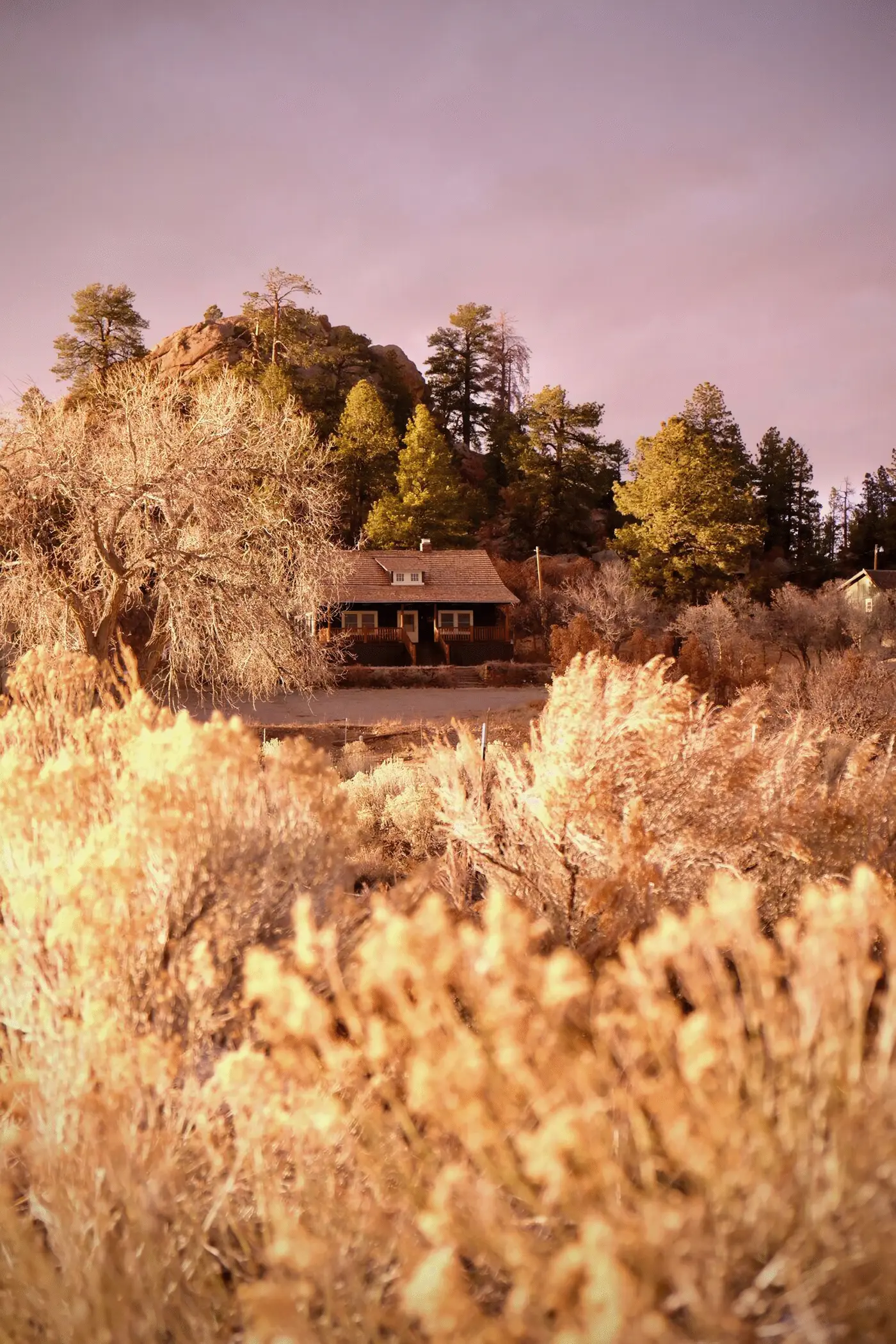
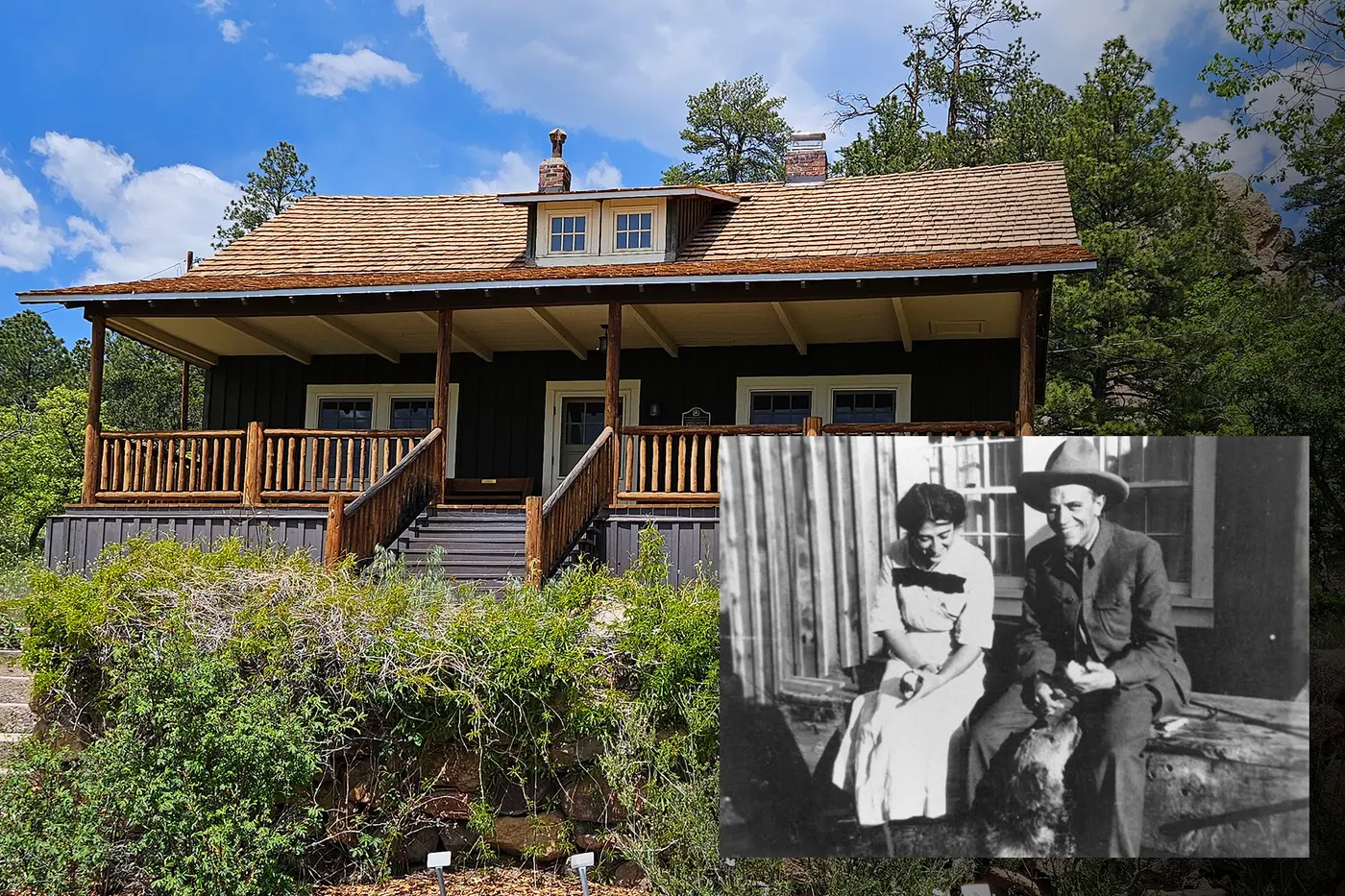
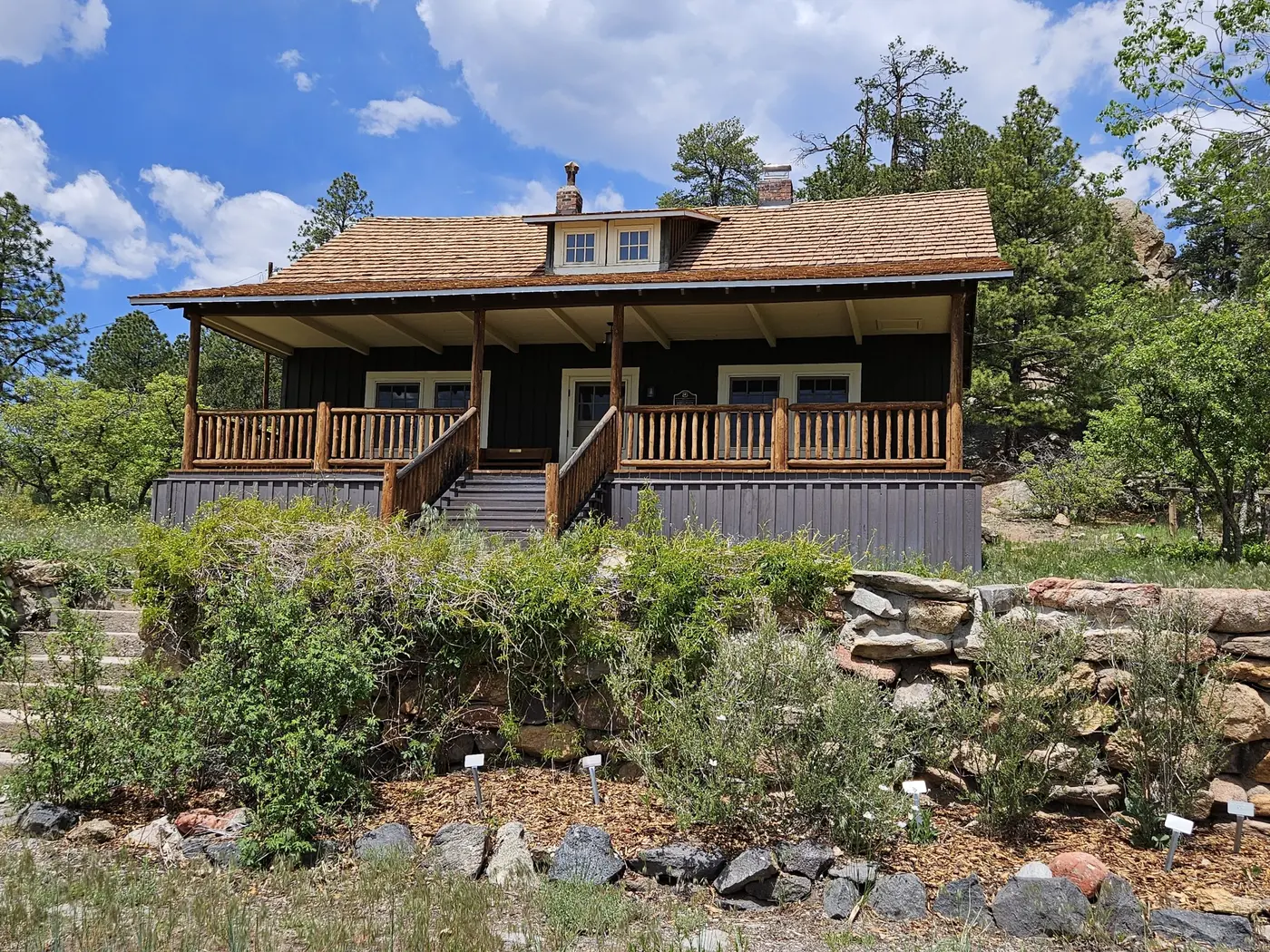
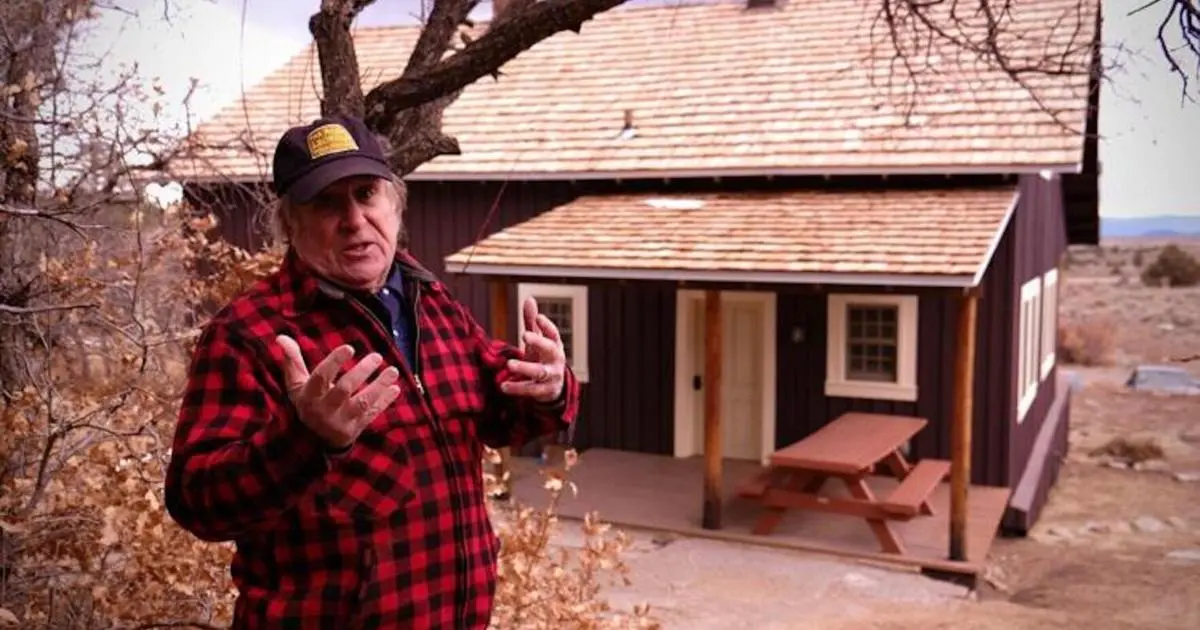
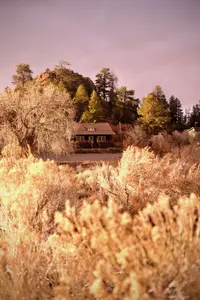
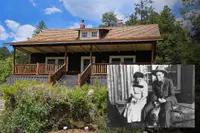
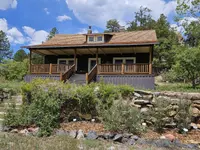
The front porch of the Aldo Leopold House runs the full 38-foot width of the building and faces east. From it the view crosses the great sage plain and the Rio Grande Gorge to Wheeler Peak, New Mexico’s highest, and the Sangre de Cristo Range. Behind the house rises the central of the Tres Piedras, three granite masses that stand 150 to 200 feet above the country just north of the settlement of Tres Piedras in Taos County. The house sits at the eastern base of the middle rock. A guest can walk out the back door and start scrambling up granite outcrops that run for miles westward toward the Brazos Mountains. In front, electricity lines hum over a pair of propane tanks, and cars pass on U.S. 285.
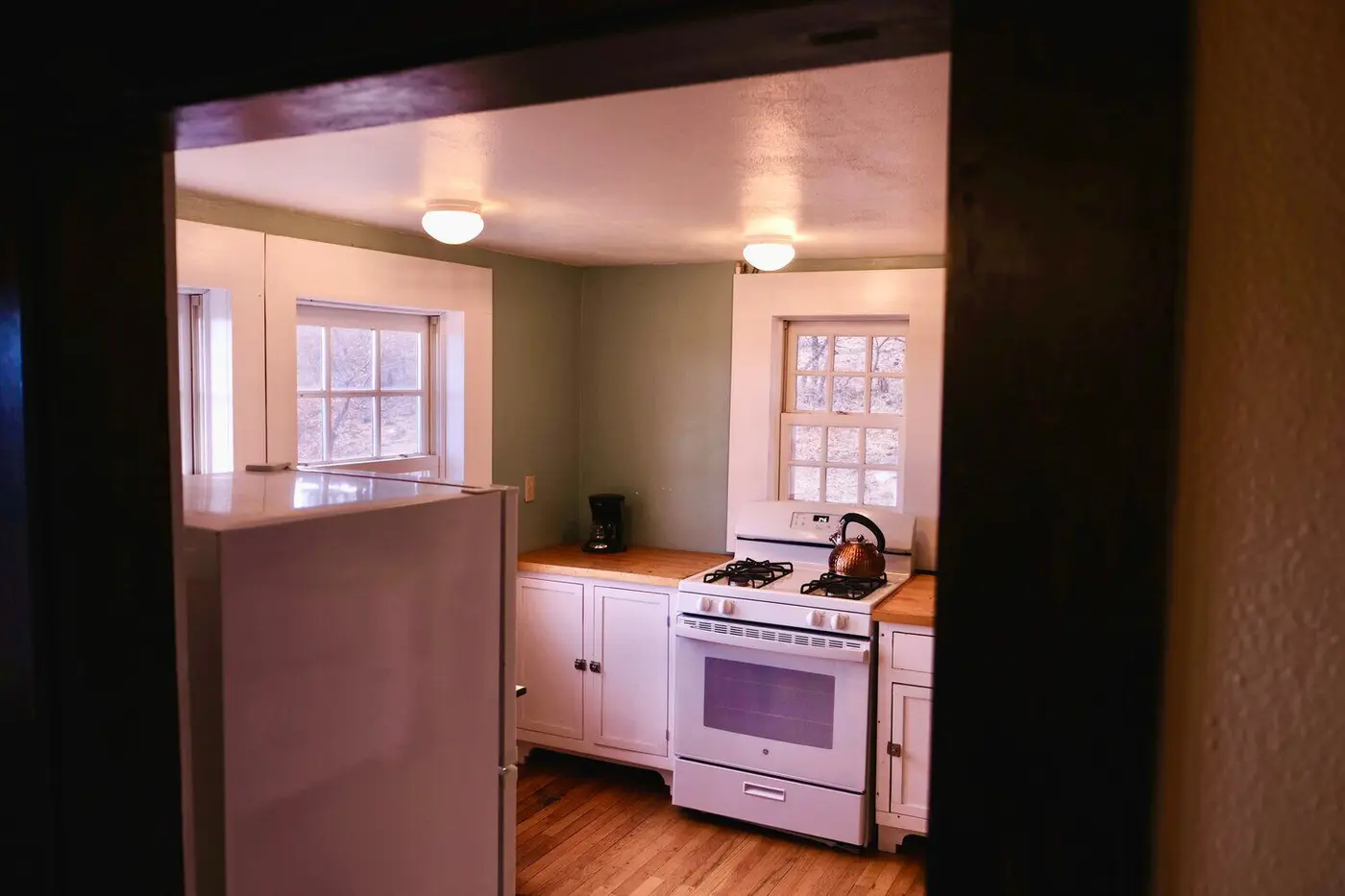
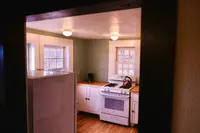
Carson National Forest rents the house spring through fall to parties of up to eight. One queen bed is on the first floor. A second queen and six twins are upstairs, reached by steps the Forest Service calls very steep and not suitable for people with mobility issues. The single bathroom is downstairs, with a claw-foot tub and a shower sprayer. The kitchen is painted robin’s egg blue and has a gas range, refrigerator, microwave and coffee maker. Guests bring their own drinking water, bedding, towels and food, and they carry out their trash. Cell service is thin, and the nearest gas station is 30 miles north in Antonito, Colorado. The house stands inside an active Forest Service compound on the Tres Piedras Ranger District.
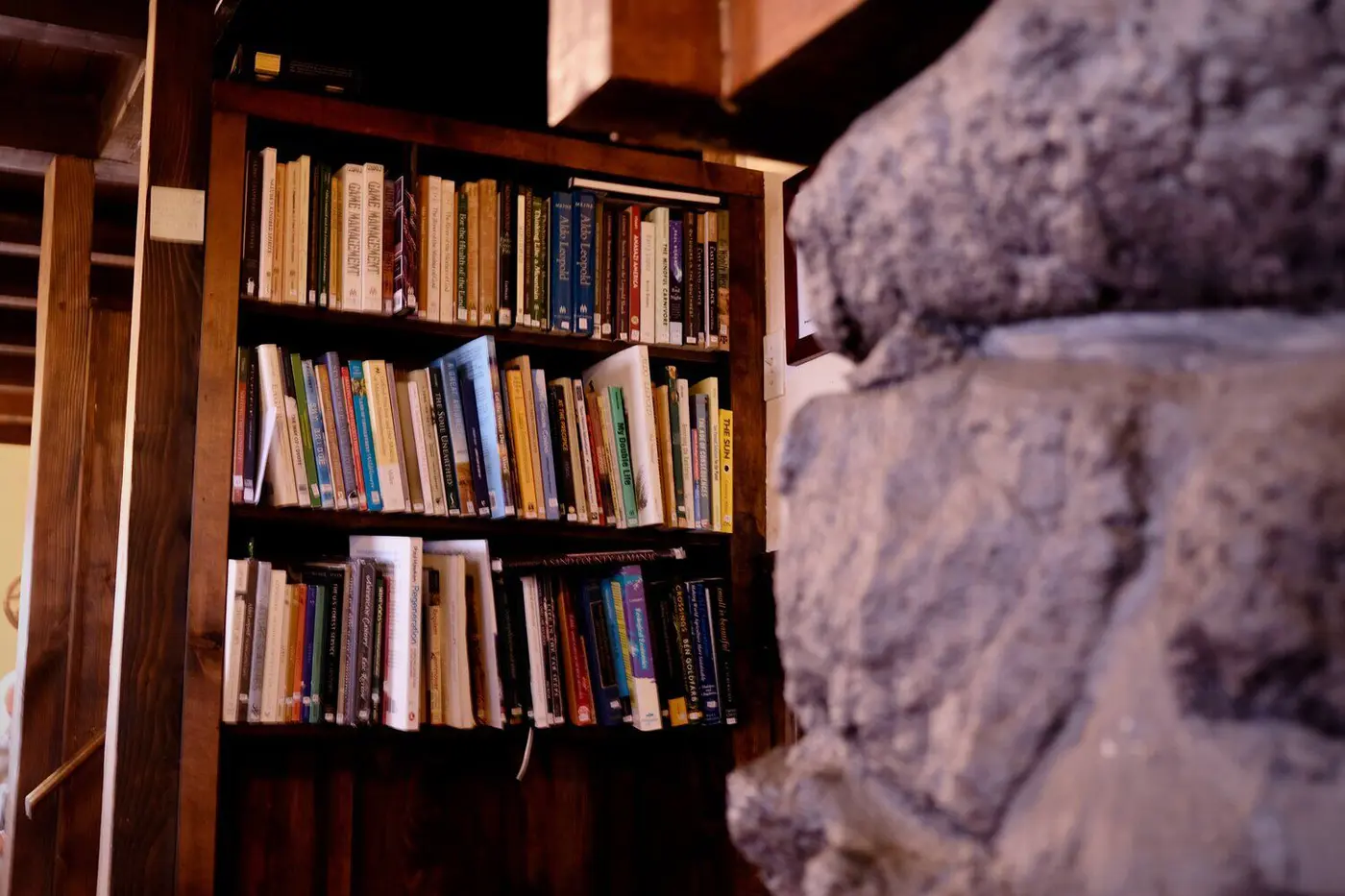
The living room keeps its dark walnut-stained beams and windowsills and its hardwood floors. Leopold and a fellow ranger, Walter Perry, processed that timber at Tres Piedras. The original ceiling beams show deep marks from heavy hammer blows. The fireplace of basalt is said to have been built of volcanic rock to Leopold’s exact specifications. It has been refurbished, but no fires are allowed. On the mantel are three black-and-white photographs of Leopold: one with his wife Estella, one with his horse, and one crouched alone in tall grass. Around the corner a shelf holds artifacts found on the property since the Leopolds’ day. Angie Krall, district ranger for the Carson’s West Zone, has spoken about how the house sits low among the boulders: “I think he was really ahead of his time with a building that fits in with the landscape, that gets that solar gain.”
Plans drawn in December 1911
On February 2, 1912, Leopold wrote to his fiancée, Estella Bergère, in Santa Fe. He told her the Forest Service had appropriated $650 to build a new supervisor’s quarters he had designed at Tres Piedras. The Taos News reckons the sum at a little less than half his salary of $1,400. His blueprints, signed and dated December 1911, show a kitchen, bathroom, bedroom, library and dining room on the first floor. The porch looking out on the Taos Valley takes up almost half the square footage of the interior.
He and Perry built the house in the summer of 1912. The 1993 National Register nomination found it very little altered from Leopold’s drawings and listed the known changes:
- The southwest corner, first a porch, was enclosed as a pantry and laundry.
- The second floor, first one large bedroom, was partitioned into three.
- The dormer’s flat roof became pitched.
A 2016 Taos News account describes the original as a one-and-a-half-story bungalow. A 2025 account in the same paper says a Civilian Conservation Corps renovation in the 1930s raised the roof to make a full second story.
The couple called the house Mi Casita, “My Little House.” The Forest History Society credits the name to Estella, a Santa Fe native, whose full name it gives as Maria Alvira Estella Bergère Leopold. The Santa Fe New Mexican gives her name as Estella Luna Otero Bergere. J.R. Logan, writing in the Taos News in 2016, reported that the Leopolds themselves said “Mia Casita,” and that some literature uses the correct Spanish.
A supervisor on the west side of the gorge
Leopold came to the Carson from the Apache National Forest in Arizona. The National Register nomination dates his arrival to May 1911. In Arizona he had shot a female wolf and, as he wrote years later, watched the “fierce green fire dying in her eyes.” According to Logan, Leopold moved the forest office from Antonito to Tres Piedras because it shortened the trip to Santa Fe. That gave him more chances to court his bride-to-be and to fend off other suitors. On September 25, 1911, he wrote to her from Tres Piedras:
“San Antone Mountain was a great glory of bronze and gold — and the Taos Mountains — 60 continuous miles of main range under the eastern sky — ablaze with great masses of orange and crimson. I can hardly tell you what a blessed peace I find in my Sundays in the hills.”
In the spring of 1912, at 25, he was named supervisor of the million-acre Carson. The Alamosa Citizen says he first served as deputy supervisor. He spent most of his days wrangling sheepherders and changing rangeland practices to undo the damage of abusive grazing, and he often wore a six-shooter on duty. Krall has described the other side of that work: “For Hispano and Indigenous populations, he’s not necessarily a hero. They thought he was a good man, but he certainly represented a major change in the way land was managed in New Mexico.”
Leopold was often gone for days at a time. Curt Meine’s biography of him, as Logan relates it, tells of Estella, raised in the city, seeing a mountain lion on an outcrop visible from the kitchen window. She learned to cook, cut hair and hunt.
Sources differ on how long the couple stayed:
- The Taos News puts their time in the house at nine months, and in its 2025 account has Leopold arriving in October 1912.
- The Register nomination says he left the Carson for good in March 1913.
- Logan gives April 1913.
- The Forest History Society speaks of “his two years here.”
All agree he left after a serious illness, caught while settling a grazing dispute in a bad storm. He took a desk job with the Forest Service in Albuquerque. In 1914 he founded the Game Protective Association, later the Albuquerque Wildlife Federation, and he went on to Wisconsin and A Sand County Almanac. “It’s those 13 years in New Mexico and a year and a half in Arizona which were really powerful and inspirational for him,” said Richard Rubin, the house’s longtime volunteer steward.
Root cellar, barn and corral
The house stands at the center of an eight-acre historic district, listed in the National Register on August 5, 1993, as the Old Tres Piedras Administrative Site. Its parts include:
- Root cellar. Built at the same time as the house, 25 feet behind it. It is dug into loose granite talus at the foot of the rock and walled with native granite, basalt and quartzite.
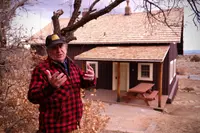
- Office. Built at the same time as the house but six miles to the west, and moved to its place about 50 feet south of the house sometime after 1917.
- Barn. Built in 1931, about a hundred feet north of the house.
- Barn corral. Built of peeled ponderosa saplings. Its far side is the vertical granite face of the central rock.
- Water works. A cistern and an earth-bermed water impoundment once supplied domestic water. The Santa Fe New Mexican describes two large concrete blocks on the property as gravity-fed water-catchment systems.
The nomination calls the district “a perfectly preserved and classic representative of the early history of the National Forest Service.” It dates from a time when running a national forest “essentially was a one-man operation.” That man lived between the building where he administered the forest and the barn that sheltered his pack and riding animals. The nomination also records that the house “has served continuously as a family residence from his day to ours.” The National Register’s Keeper amended the listing to rest on architecture alone. Because no other area of significance had been claimed, the Keeper struck Aldo Leopold’s name from the Significant Person space.
Restoration, writers and a shelf of books
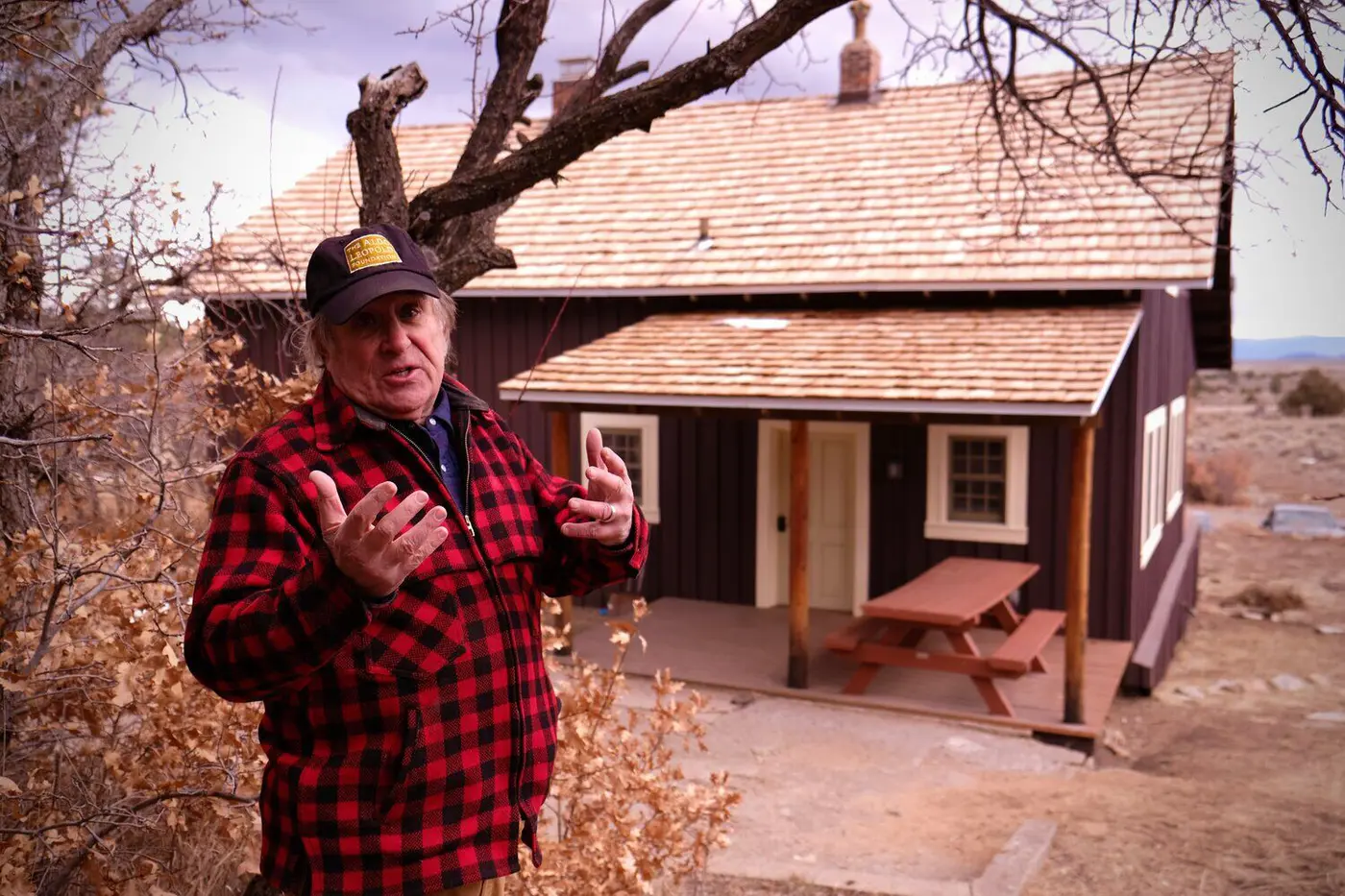
A 2005 restoration plan set the house’s purpose. “The house will function as a retreat for persons interested in modern conservation issues and as an interpretive site,” it reads. Historicorps and the Carson did the work. Recreation.gov dates it to 2005, the Alamosa Citizen says the full restoration was completed in 2006, and the Forest History Society gives 2005–2006. Electricity and heating were wired through the house. Rubin raised money through the Taos Community Foundation for exterior paint, stair railings, porch repairs and a new gas stove. More recently, federal infrastructure money paid for a treated cedar-shingle roof, a septic system sized for eight, and repairs to the chimney.
In 2012 the Leopold Writing Program began residencies. Writers could stay up to a month between May and October and agreed to present their work publicly in Taos. In 2016 the Forest Service proposed nightly rentals at $175. It announced them on January 11, 2025, Leopold’s birthday, and overnight stays began that May. These were the first cabin rentals on National Forest land in New Mexico. Two months a year remain reserved for the writers.
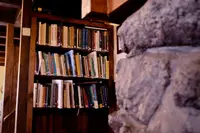
The library began with sixteen books by and about Leopold, given by the Albuquerque Wildlife Federation in memory of University of New Mexico professor Richard Becker. It held nearly 150 volumes in January 2025 and 175 a year later. The widow of historian Harold Steen gave a dozen of his works. Professor Tom Swetnam gave early Forest Service manuals inherited from his ranger father, among them Gifford Pinchot’s Primers of Forestry and Use Book. Robin Wall Kimmerer’s Braiding Sweetgrass sits beside Jim O’Donnell’s Fountain Creek: Big Lessons from a Small River.
On a January afternoon in 2025, Richard and Annette Rubin walked out the screen door to the front porch as a winter storm closed over the Sangre de Cristos. They sat on a bench of Leopold’s design. “He just loved the view from the porch,” Annette Rubin said.
Notable Events
- 1911Leopold was transferred to Tres Piedras from the Apache National Forest in Arizona in 1911. fs.usda.gov
- 1911Leopold came to the Carson in May of 1911. npgallery.nps.gov
- 1911Blueprints signed by Leopold and dated December 1911 show a kitchen, bathroom, bedroom, library and dining room on the first floor; a massive porch looking out on the Taos Valley was almost half the square footage of the house's interior. taosnews.com
- 1912Aldo Leopold wrote to his fiancee that the Forest Service had appropriated $650 to build a new supervisor's quarters he had designed at Tres Piedras. fs.usda.gov
- 1913Leopold left Mi Casita in 1913 after falling ill while resolving a grazing dispute. discovertaos.com
- 1917The Office, built at the same time as the House six miles to the west, was not moved to its present location until sometime after 1917. npgallery.nps.gov
- 1931The Barn was built in 1931, about a hundred feet north of the House. npgallery.nps.gov
- 1993The Old Tres Piedras Administrative Site was listed in the National Register of Historic Places, NRIS Reference Number 92000341. npgallery.nps.gov
- 2005A 2005 plan aimed to preserve the house's historic integrity while introducing modern amenities. discovertaos.com
- 2005The house was restored to its original appearance in 2005-2006. foresthistory.org
- 2006Historicorps completed a full house restoration in 2006; private funding was provided through the Taos Community Foundation, where local volunteer Dr. Richard Rubin fundraised and led major improvements. alamosacitizen.com
- 2012The Leopold Writing Program began residencies at the house in 2012. foresthistory.org
- 2025Starting this spring, Carson National Forest is making the Aldo Leopold House, which sits off Highway 285 as travelers make their way through northern New Mexico, available as a rental, becoming the first cabin rental on National Forest land in New Mexico. alamosacitizen.com
People
- Dr. Richard Rubin, longtime site steward; local volunteer at the Taos Community Foundation who fundraised and led major improvements including exterior painting, installing stair railings, repairing the porches and purchasing a new gas stove.
- Annette Rubin, Longtime steward of Mi Casita.
- Walter Perry, fellow ranger and writer who built the cabin with Leopold in 1912.
- Maria Alvira Estella Bergère Leopold, Aldo Leopold's new wife; named the house Mi Casita.
- Richard Rubin, Volunteer steward of the house.
- Aldo Leopold, Built the house as his family residence (May of 1911 to March of 1913).
- Estella Bergère, Leopold's fiancée in Santa Fe.
- Angie Krall, district ranger for the Carson National Forest West Zone; former archaeologist with experience restoring cabins on the neighboring Rio Grande National Forest; quoted on the cabin's solar-gain design and the land-ethic origins.
- Estella Luna Otero Bergere, Leopold's new wife; the house was built as the supervisor's quarters where the couple would reside.
Sources
- fs.usda.gov/r03/carson/recreation/aldo-leopold-house
- recreation.gov/camping/campgrounds/273779
- taosnews.com/la-vida/aldo-leopold-s-life-felt-in-historic-tres-piedras-mia-casita/article_e1a7c2fa-7fe0-5610-94cf-24235d486d8a.html
- discovertaos.com/aldo-leopold-house-opens-for-public-rentals
- alamosacitizen.com/historic-aldo-leopold-house-to-be-available-for-overnight-stays
- santafenewmexican.com/news/local_news/carson-national-forest-opens-aldo-leopold-house-to-public-rentals/article_0237a9ba-d8de-11ef-b9f5-031f0732b229.html
- npgallery.nps.gov/NRHP/GetAsset/NRHP/92000341_text
- foresthistory.org/the-history-library-at-the-leopolds-carson-national-forest-home