Glendale
Maricopa County, Arizona.
Glendale, in Maricopa County, Arizona, began in 1892 as a temperance colony of Brethren and River Brethren families on Arizona Canal lands promoted by Murphy.1
Details
- Founded
- Glendale dates its founding to 1892, when William J. Murphy and Hadsell filed Hadsell’s Addition; the city marker gives February 27 and a National Register nomination gives November.1,2
- Name
- Murphy needed a name to promote his Arizona Canal lands, and his promotional records call the site “Glendale” as early as 1885.1
- Last checked
- October 6, 2026.
Point at a dot to see the place.Tap a dot to see the place. Road map of Glendale.
In Glendale
The Calendar
History
Murphy’s Canal and the Temperance Colony
A square block of park sits at the center of downtown Glendale, in Maricopa County, Arizona; the town’s founder, William J. Murphy, gave it to the city in 1909 and made the townspeople promise to keep it a park.1 Glendale is now a suburb, and 59th Avenue is one of its busiest automobile thoroughfares.2
Murphy came to Arizona from Illinois in 1880 to build railroad, and in 1883 he took a $500,000 contract for the 40-mile Arizona Canal from Granite Reef to New River, paid in company stocks and bonds instead of cash.1 The canal was finished in 1885 and left him deep in debt, and in 1887 he formed the Arizona Improvement Company to sell the land and water rights south of it.1 The land needed a name to sell, and Murphy’s promotional records call the site “Glendale” as early as 1885.1 With irrigation water from the Arizona Canal in the area since early 1885, William H. Bartlett, a grain broker from Peoria, Illinois, claimed 640 acres in 1886 for Sahuaro Ranch, which his managers built into a farm of fruit, olives, nuts, and livestock though he never lived there full-time.3 In 1888 Murphy built Grand Avenue, an 18-mile diagonal road from Peoria to downtown Phoenix, to give the settlement better access.1
Homesteaders were still too few, so in 1891 Murphy worked with Burgess Hadsell to bring 70 Brethren and River Brethren families to form a temperance colony, whose religious beliefs barred the sale of liquor.1,2 The city’s marker gives February 27, 1892, when Murphy and Hadsell finished filing Hadsell’s Addition, nearly a section cut into thirty twenty-acre lots, as Glendale’s official birthday.1 One National Register nomination instead dates the official founding to November 1892, and says the first families arrived that spring and settled on the twenty-acre lots.2
Floods, Drought, and the Beet Sugar Factory
Murphy traded the right-of-way along Grand Avenue for a railroad from Prescott to Phoenix, which built an ice house and depot in Glendale.1,2 By 1895 the town had 300 people and an elementary school, and that year Vic Messenger came to manage Ryder Lumber and Hardware Company, carrying 400 books that he donated as the first library collection open to the public.2,4 A flood in 1895 washed out the headgates of the Arizona Canal and sent a wave of water down onto Glendale, and in 1897 a three-year drought began.2
In 1903 Murphy and others organized the Arizona Sugar Company, and he found financing for a one-million-dollar beet sugar factory, though money troubles delayed its construction.1,2 Starting in 1907, labor poured in to work at the sugar factory, five subdivisions were added from 1908 to 1911, and the sugar company platted a Sugar Addition to house its workers.2 Residents incorporated as the Town of Glendale and chose a sugar beet as a municipal symbol, and an electric trolley line Murphy built from Phoenix ran between 1911 and 1925.1,2 Voters created the Glendale Union High School District in 1911 and its school opened in 1913, while Russian immigrants arrived alongside a growing number of Hispanic residents, drawn by jobs in the factories and fields.2 In the fall of 1914, Glendale State Bank president Lafayette Myers persuaded Otto Hansen, a Wisconsin investor, to develop an 80-acre tract as Catlin Court, Catlin being his wife’s maiden name.5
The end of World War One in 1918 brought a depression in farm prices that hit bottom by 1921 for farmers who had planted heavily to cotton, and no new subdivision was platted for seven years.2 The farm economy had begun to recover by the mid-twenties, and in 1930, with 3,665 people, residents dropped town status and became the City of Glendale.2 In 1940 the Arizona state guide found Glendale at the center of a productive farm district, with cotton gins, a cotton-oil mill, flour and feed mills, and packing sheds for grapes, lettuce, and cantaloupes.6 The guide said the town, settled in the 1890s, made little progress until Roosevelt Dam assured a dependable water supply, and it counted Mexicans as about twenty-two per cent of the population, supplying much of the field labor.6
Part-Time Farms and Two Air Fields
The federal Resettlement Administration built the Glendale Tract in 1937 at 51st Avenue and Northern Avenue, then the edge of town.7 Glendale building contractor John D. Howell had 135 men on the project by February 1937, and Dorothea Lange photographed the tract for the FSA that May.7
In February 1941, one month after the Thunderbird civilian pilot school was established, the Army Air Corps announced a second military training installation, a large air base ten miles west of Glendale.7 Thunderbird’s airfield became a school that graduated its first class in 1947, and by 1950 Glendale, ringed on three sides by military facilities, had more than 8,000 people.2,7,8
Terra Cotta, the Sky Parlor, and Sahuaro Ranch
Downtown grew between 1896 and 1921, and the city’s marker calls Glendale then the largest town in the northwest Salt River Valley, where farmers shipped fruit, vegetables, and livestock to national markets.9 Its role changed by the 1960s as the automobile offered other shopping, and since the 1980s businesses and city government have worked to make it a regional destination again.9 In 1918 C. H. Tinker, mayor 1918-20, bought a former pool hall for his Security State Bank, renamed it the First National Bank of Glendale, and added a terra cotta façade that its marker calls the oldest in the Salt River Valley.10 The beet sugar factory at 52nd Avenue and Glendale Avenue, which long-time residents call the Sugar Beet Factory, was the first historic building in Glendale listed on the National Register.11
Louis M. Sands, a pioneer of modern Arizona cattle ranching, bought Manistee Ranch in 1907, named it for his Michigan hometown, and worked out ways of rotating cattle pastures there; its 1897 Queen Anne house carries a square windowed tower called the “Sky Parlor.”12 In 1977 Richard S. Smith and his wife Sharon sold the last 160 acres of Sahuaro Ranch to developers and the city, and the 80 acres the city bought hold the old ranch buildings, kept as a reminder of Glendale’s farm past.3
Within 30 Miles
Measured in a straight line from the town, nearest first.
- Dorrance DOME at Arizona Science CenterPhoenix · Planetarium - a permanent feature of the arizona science centerAn LED dome opened in October 2025 that welcomes 205 guests in 200 premium seats, plus five ADA-compliant spaces.

- Billy Moore DaysAvondale · Multi-day festivalA four-day October carnival and Saturday-morning parade in Avondale, Arizona, honoring Billy Moore, a Coldwater postmaster who, the local historical society says, dispensed moonshine with the mail.
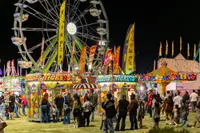
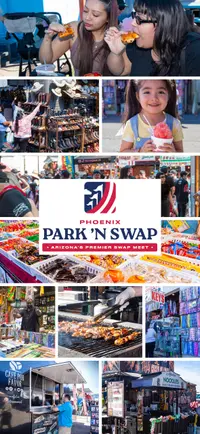
- Phoenix Park 'n SwapPhoenix · Flea market & swap meetOpen-air swap meet with over 1,000 vendor selling spaces plus Auto Row vehicle sales, drawing more than a million visitors a year; new and used bargains, food concessions, and monthly promos.
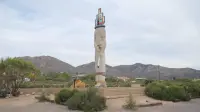
- World's Tallest Kachina DollCarefree · Roadside attractionStanding nearly 40 feet tall, the massive Kachina doll statue is believed by some to be the largest of its kind. Built in the 1970s as the neighborhood developed, the structure weighs about 14.5 tons and is made of cement blocks and steel.
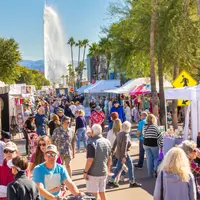
- Fall Fountain Festival of Fine Arts and CraftsFountain Hills · Juried festivalA juried arts and crafts fair held each November and February along the Avenue of the Fountains in Fountain Hills, Arizona, begun in Fountain Park with 60 artists in 1974.
- Fountain Hills OktoberfestFountain Hills · Annual festivalA two-night German festival at the Fountain Hills Community Center in Arizona, hosted by the town's Sister Cities group, with a band that flies in from Germany every year.
All the towns of Arizona. More of Arizona: Old-Time Music and Flea Markets.
Sources
- William J. Murphy (historical marker) hmdb.org/m.asp?m=30433
- National Register nomination, 59 Avenue Residential Historic District npgallery.nps.gov/GetAsset/7b0a845b-8822-46f8-ab0b-e4892897583b
- Welcome to Sahuaro Ranch (historical marker) hmdb.org/m.asp?m=40656
- First Glendale Library azmemory.azlibrary.gov/nodes/view/38809
- Glendale Townsite (historical marker) hmdb.org/m.asp?m=30477
- Arizona: A State Guide (1940), p. 354 archive.org/details/arizonastateguid00writmiss/page/354
- National Register nomination, Glendale Tract Historic District npgallery.nps.gov/GetAsset/6070fd92-5baf-4c70-a3aa-801087d1bc9a
- Listening to Glendale’s Past azmemory.azlibrary.gov/nodes/view/359
- Glendale Business District (historical marker) hmdb.org/m.asp?m=30474
- First National Bank of Glendale Building (historical marker) hmdb.org/m.asp?m=171615
- City of Glendale, Arizona Historic Properties Listed on the National Register of Historic Places azmemory.azlibrary.gov/nodes/view/39222?highlights=WyJHbGVuZGFsZSJd&keywords=Glendale&type=all
- Manistee Ranch (historical marker) hmdb.org/m.asp?m=30500